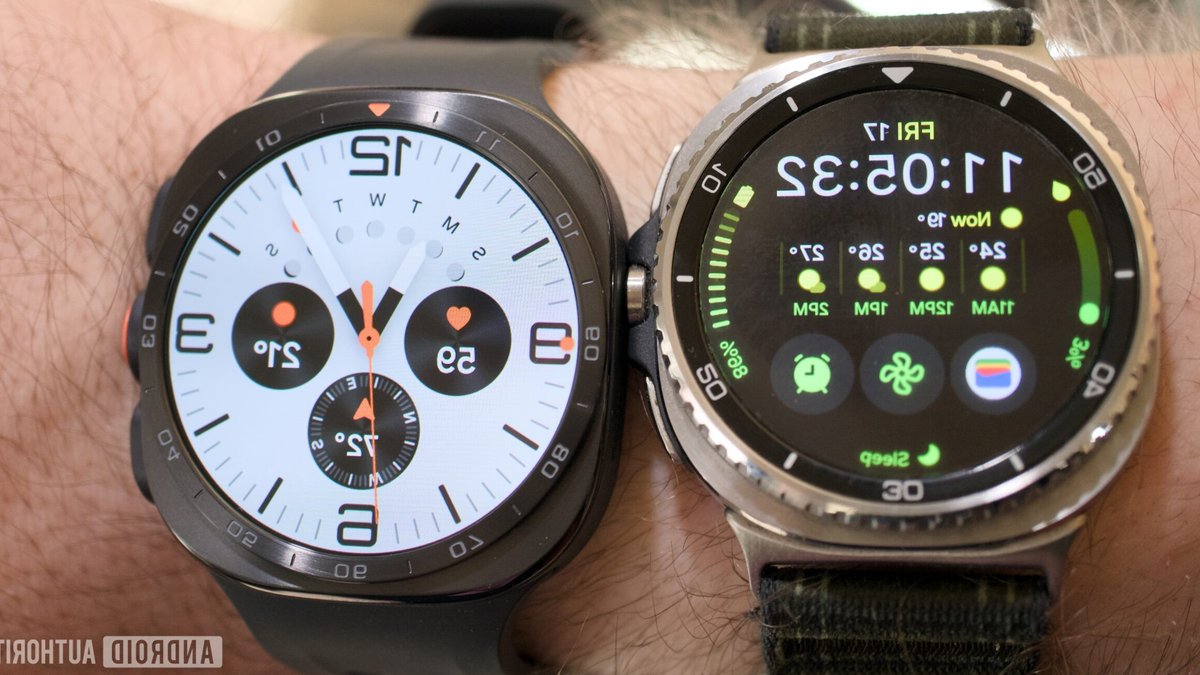
Samsung’s latest Galaxy Watch Ultra 2 arrives with Qualcomm’s Snapdragon Wear Elite processor and an 800 mAh battery, yet the company’s official specifications still claim “up to 60 hours with Always‑On Display,” the same figure advertised for the prior Ultra model that used a 590 mAh Exynos W1000 chip.
Battery capacity versus advertised runtime
The new watch’s battery is roughly 35 percent larger than its predecessor, a jump that would normally translate into noticeably longer usage time. Instead, Samsung’s spec sheet repeats the prior claim of 60 hours with the display always on, and 40 hours without it for the broader Galaxy Watch 9 line, which also moved to the Snapdragon Wear Elite platform.
Observers noted that the newer SoC may not offer a clear efficiency advantage over the older Exynos component.
Hardware changes that may affect power draw
The Ultra 2’s Super AMOLED screen can peak at 5,000 nits, an increase from the 3,000‑nit ceiling of the original Ultra. While the peak brightness only appears on a small portion of the screen for brief moments, the higher maximum could still raise average power consumption during bright‑light conditions.
Related: Memory shortage shrinks PC market 4% Apple up
Resolution also nudged up from 480 × 480 pixels to 498 × 498, a modest change that alone is unlikely to offset the battery size increase. Nonetheless, the combination of brighter output and a slightly larger display area may contribute to the unchanged runtime figures.
Similar patterns appear across the mid‑range lineup. The Galaxy Watch 8 offered 325 mAh and 435 mAh cells for its 40 mm and 44 mm variants. The subsequent Watch 9 raised those capacities to 390 mAh and 445 mAh, yet Samsung continues to list the same “up to 40 hours without Always‑On Display” claim for all four models.
Both the Ultra 2 and the Watch 9 series share the shift to Snapdragon Wear Elite, suggesting the processor’s power profile may not be delivering the expected gains. If the chip were substantially more efficient, the larger batteries should have produced longer advertised usage.
There is also the possibility that the company simply has not updated its marketing numbers. No detailed breakdown of how the new SoC’s power characteristics compare to the older Exynos design has been provided.
Analysts await official comment.
Related: China Chip Shipments to Hit 5 Million
From a broader perspective, the situation mirrors earlier transitions where manufacturers upgraded silicon but kept legacy battery life claims unchanged, often to avoid confusing consumers with shifting figures. In those cases, the actual efficiency gains were later confirmed through independent testing, but the initial marketing remained static.
Potential improvements could include smoother app launches, quicker sensor readouts, or better handling of demanding health‑tracking features.
If the processor does enhance responsiveness, users might accept the unchanged battery claim as a trade‑off. However, without clear data on power consumption, it is difficult to assess whether the Ultra 2 truly offers a superior experience over its predecessor.
Future reviews that measure actual screen‑on time, standby endurance, and performance under load will be essential to determine if the Snapdragon Wear Elite fulfills its promise. Until then, the advertised parity in runtime remains a puzzling data point for a device that boasts a considerably larger battery.