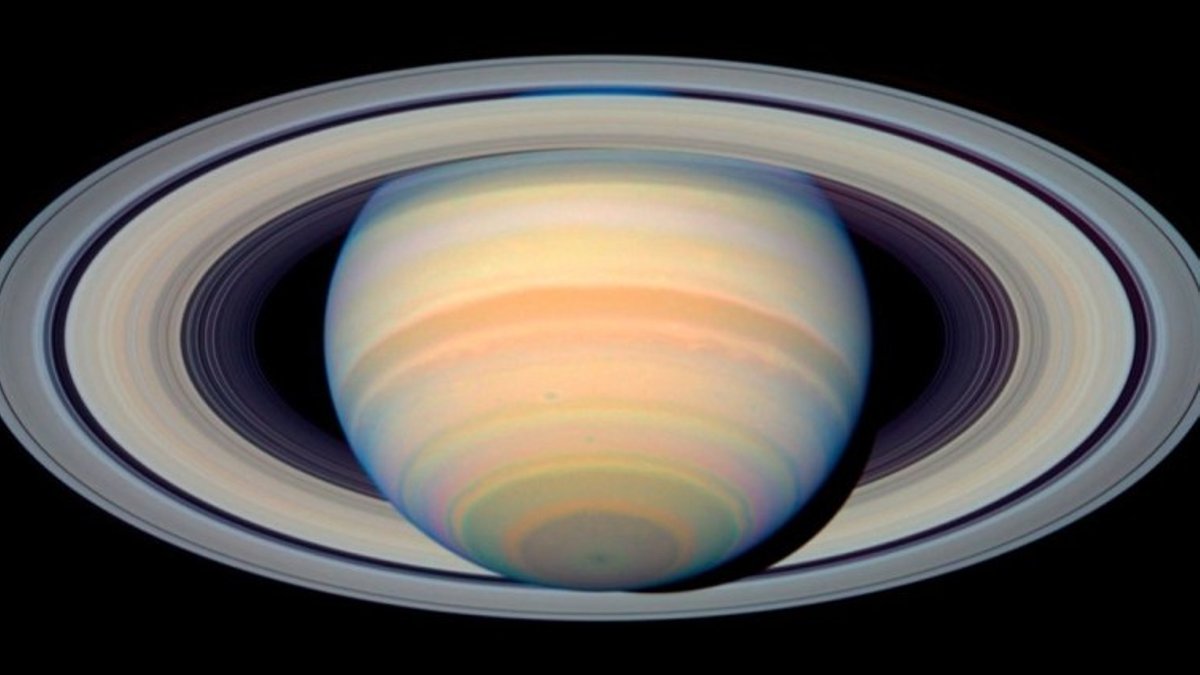
Saturn’s south pole is now home to a confirmed ten-sided atmospheric wave, also known as a decagon, according to a recent study published in the journal Science Advances. This discovery marks the first time a large, regular-sided jet-stream pattern has been detected at Saturn’s southern pole.
The decagon was first spotted by amateur astronomers Trevor Barry and Jean-Paul Oger in 2024, who submitted their images to the Planetary Virtual Observatory Laboratory, a crowd-sourcing platform managed by the University of the Basque Country.
An international team led by Agustín Sánchez-Lavega of the University of the Basque Country in Bilbao, Spain, confirmed the decagon’s presence using Hubble’s Wide Field Camera 3, which photographed Saturn in multiple wavelength bands from above Earth’s atmosphere.
Amy Simon, study co-author and principal investigator of NASA’s Outer Planet Atmospheres Legacy program at NASA’s Goddard Space Flight Center in Greenbelt, Maryland, stated that the team had never seen anything quite like this in Saturn’s southern hemisphere.
The decagon appears to be strengthening, giving researchers a rare opportunity to watch a giant atmospheric pattern develop.
Saturn’s rapid rotation, with a day lasting only about 10.7 hours, drives the Coriolis force to route atmospheric flow into discrete latitudinal bands, resulting in a system of alternating jet streams. The decagon is thought to be a result of this process, with the jet stream tracing a path of sharp, roughly equal straight sides rather than a circle.
Related: Legacy stuns Falcons again to reach CS2 semis
The discovery of the decagon has significant implications for our understanding of giant planet atmospheres and their potential for forming geometric polar waves.
Future observations, including those from the James Webb Space Telescope, will help establish whether the decagon’s sharpening trend has continued and provide insights into its vertical structure, temperature profile, and composition. Computer modeling will also be used to test candidate formation mechanisms.
Researchers may uncover new information about the air defense systems of giant planets and their potential relationships to Earth’s weather patterns as they continue to study the decagon.
The study’s lead author, Agustín Sánchez-Lavega, noted that the discovery of the decagon suggests that the hexagon is not as extraordinary as previously thought, and that systematic searches for similar features on other planets are now scientifically motivated.
It will be subject to scrutiny and discussion by the broader planetary science community.