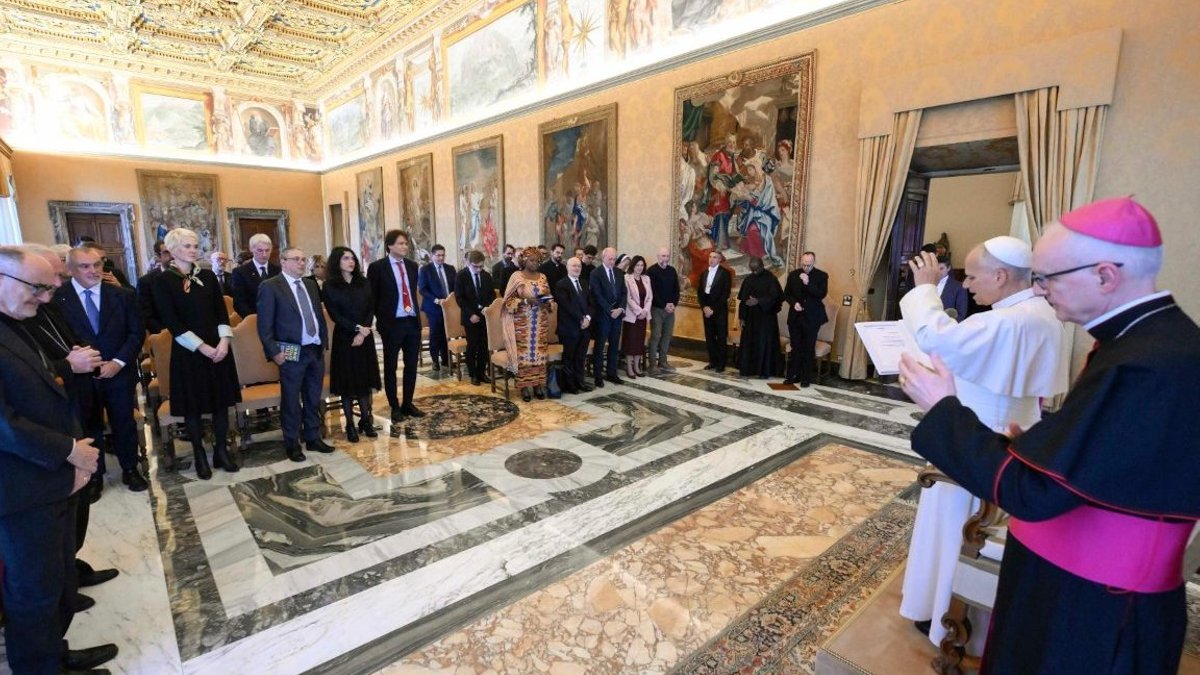
Pope Leo XIV addressed a gathering of AI experts at the Vatican, 17 days after lung cancer surgery. His speech, a concise 740 words, outlined five key points on AI’s role in society, marking the most significant interaction between a pope and AI to date. This engagement shows his deep commitment to the topic, especially given the recent health challenge.
The pope emphasized that AI’s future is not predetermined and urged society to critically question its purpose. He stressed that machines are tools, not persons, warning against granting AI legal personhood, which could leave victims of AI-related harm without a clear accountable party. This stance reflects his broader concern about the ethical implications of AI integration into daily life.
AI Governance and Accountability
Pope Leo XIV highlighted the need to retain human control over critical decisions involving life, freedom, and force. He specifically called for a ban on lethal autonomous weapons and urged the November Geneva meeting to take concrete steps toward this goal. This call aligns with ongoing discussions under the UN weapons convention, which have been active since 2014, with a formal expert group established in 2016. After 12 years of deliberation, the review conference scheduled for November 16-20 will decide whether to begin negotiating a treaty. Despite these efforts, progress has been slow, contrasting sharply with AI’s rapid evolution from photo labeling to software writing in the same period.
Read Also: Seattle Power Outage Knocks KEXP Streaming Offline Globally
The pope also cautioned against allowing AI to become an end in itself or serve only the interests of a privileged few. He advocated for international institutions to implement these principles, ensuring the global common good. However, this proposal faces skepticism due to the UN’s limitations, as evidenced by its inability to act decisively during the 2022 Ukraine invasion. Despite the General Assembly’s 141-5 vote demanding Russia’s withdrawal, the invasion continued unabated, highlighting the challenges of international enforcement.
Debating International Oversight
While the pope’s call for international governance is notable, one commentator disagrees, citing the UN’s inaction during the 2022 Ukraine invasion as evidence of its limitations. They argue that international bodies are ill-equipped to regulate a rapidly evolving technology like AI, especially given the slow pace of treaty negotiations. The UN’s weapons convention discussions since 2014 have yet to yield a treaty on autonomous weapons, despite AI researchers’ calls for a ban since 2015.
Expert Perspectives on AI Risks
Max Tegmark of MIT warned against ceding control to machines, echoing the pope’s concern about accountability. Stuart Russell of UC Berkeley issued a starker warning, suggesting that unchecked AI development could lead to human extinction. These perspectives highlight the diverse risks associated with AI and the need for proactive measures to mitigate them.
Read Also: UW researchers win Madrona Prize for AI model compression breakthrough
Gary Marcus, an NYU cognitive scientist, praised Pope Leo XIV as the clearest thinker on AI among world leaders. Marcus advocates for red lines to restrict open-ended AI agents, using the example of GPS navigation systems with bounded autonomy to illustrate a practical approach. This concept, as explained by Daniel Khashabi of Johns Hopkins, involves setting limits on AI agents’ actions, spending, and tool usage, ensuring human oversight for irreversible decisions. This approach, already implemented by deploying companies, offers a more immediate solution than waiting for international treaties.
Pope Leo leaves for Uruguay, Argentina and Peru on Nov. 6. I wish him safe travels and a full recovery.