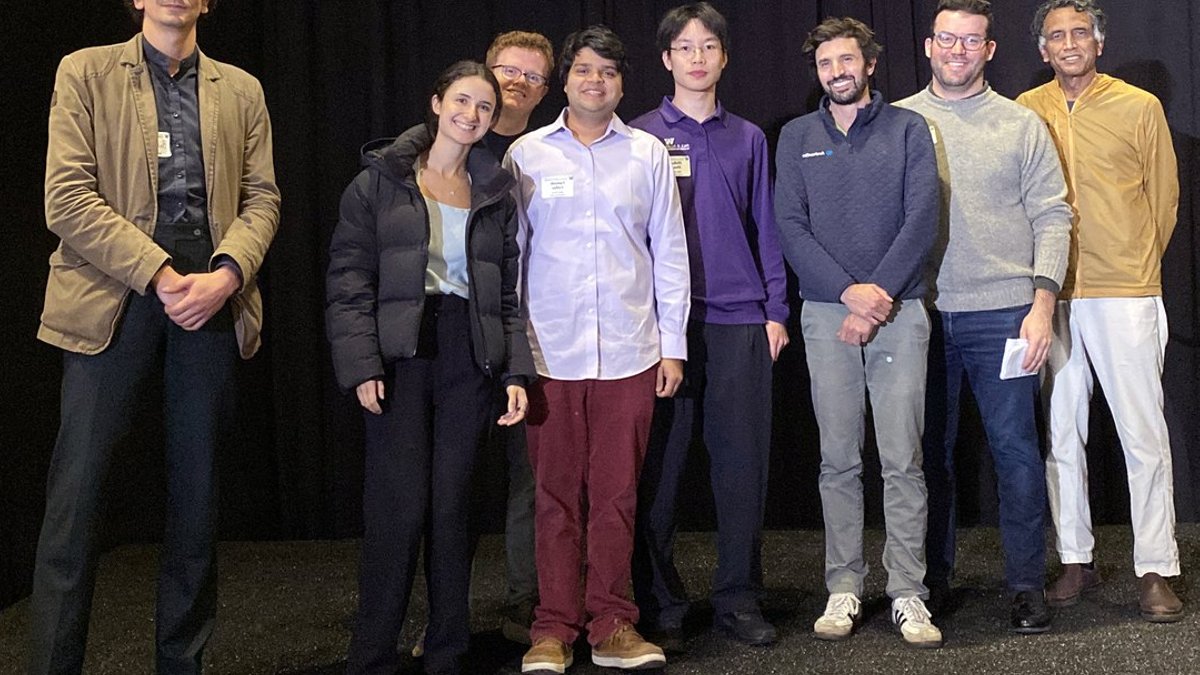
The University of Washington’s research team has earned the Madrona Prize for creating AI agents that reduce large AI models to function on small, low-power devices. Awarded since 2006 by Seattle-based venture capital firm Madrona, the prize highlights work combining academic precision with commercial viability. The winners were selected from student posters presented at the evening event on the UW campus. The project, led by PhD candidate Zhihan Zhang, addresses a critical gap: automating the compression of AI models for devices constrained by memory, power, and heat limits. Traditional AI models fail without hardware feedback, but Zhang’s system refines its approach through iterative testing against real-world performance metrics.
Within just seven testing cycles, the AI agent surpassed human experts in efficiency. The team demonstrated its effectiveness in two practical scenarios. First, they adapted a vision model for a solar-powered camera tracking elk in the wild, achieving a 250-fold reduction in size. Second, they optimized a wearable device recording children’s speech for developmental studies. The project’s benchmark, Embedded Arena, was released as open-source software to support broader adoption. Collaborators included Alexander Metzger, Jiuyang Lyu, Chun-Cheng Chang, Jiayi Shao, Yujia Liu, Emmanuel Azuh Mensah, Edward Wang, and Gregory D. Abowd alongside the Allen School faculty.
Read Also: Amazon CEO predicts two $1 trillion businesses in a decade
Other innovations showcased at the Allen School’s event addressed parallel challenges. The People’s Choice award went to VibeSys, an AI agent that generates custom software for specialized chips, handling up to 2.7 times as much work as an existing system on Amazon’s Trainium2 processors. Its first application, VibeServe, writes behind-the-scenes software to manage user requests through AI models, with contributions from Shihang (Vic) Li, Simon Peter, and Baris Kasikci.