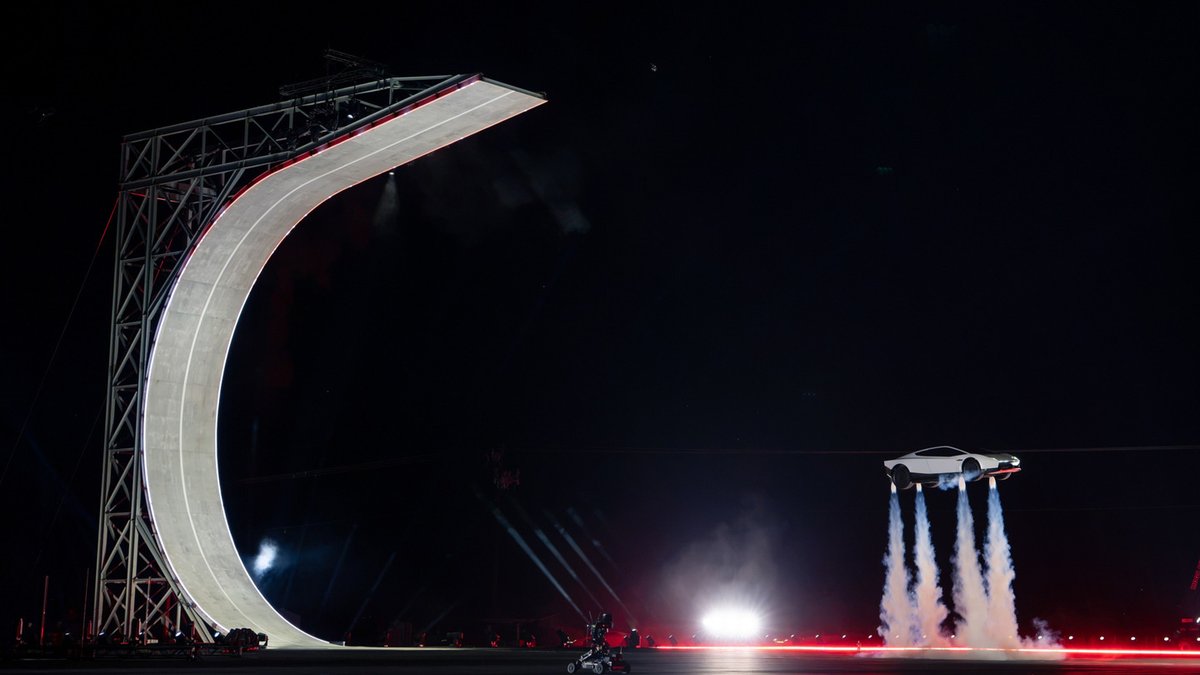
Tesla’s reintroduction of its long-delayed and still unreleased Tesla Roadster on October 15 included an unexpected feature: the ability to perform controlled aerial maneuvers using thrusters. The supercar, featuring an angular, Cybertruck-esque design and the ability to go 0-60 mph in less than a second, can execute controlled falling, jumping, and flipping maneuvers through a system of two high-pressure air tanks and ten nozzles placed throughout the car that fire off compressed air. While the concept of thruster-assisted vehicles is not new, the Roadster’s application in a consumer supercar represents a novel approach. Similar technology has been explored in military contexts, notably in missile defense systems.
Tesla Roadster Thruster Technology
The Roadster’s thrusters use compressed air, a cold-gas system that avoids fuel combustion. Tesla claims the tanks can refill autonomously, enabling repeated maneuvers. Experimental missile defense systems have featured similar uses of thrusters since at least the early 2000s, in a form factor now called a Multiple Kill Vehicle or MKV. The full thruster setup is exclusive to the Rocket trim of the car, while the Thruster trim only features thrusters on the back, and the Performance trim lacks them entirely. Tesla emphasizes that the systems are not approved for public road use.
Lockheed Martin’s MKV Project
Lockheed Martin’s Multiple Kill Vehicle (MKV) project, initiated in 2004 under a $760 million contract with the U.S. Missile Defense Agency, aimed to create a system capable of intercepting multiple ballistic missiles simultaneously. The MKV used thrusters for rapid directional changes, allowing its smaller interceptors to engage targets autonomously. Development ceased in 2009 following budget cuts, but the project exemplified advanced thruster applications in defense technology. Based on a 2008 Lockheed Martin press release, its MKV was used in “hot-fire tests” that suggest some part of the system burned fuel for propulsion.
Historical parallels exist in the Strategic Defense Initiative, or “Star Wars” program, which explored missile interception concepts since the 1980s. However, Lockheed Martin, founded in 1995, could not have directly contributed to pre-1995 SDI efforts. Alleged MKV footage often blurs with SDI-era materials, complicating historical verification. Regardless, that concept is what Lockheed Martin and another contractor, Raytheon, were working on in separate development tracks until the original MKV project was retired in 2009 as part of military budget cuts.